
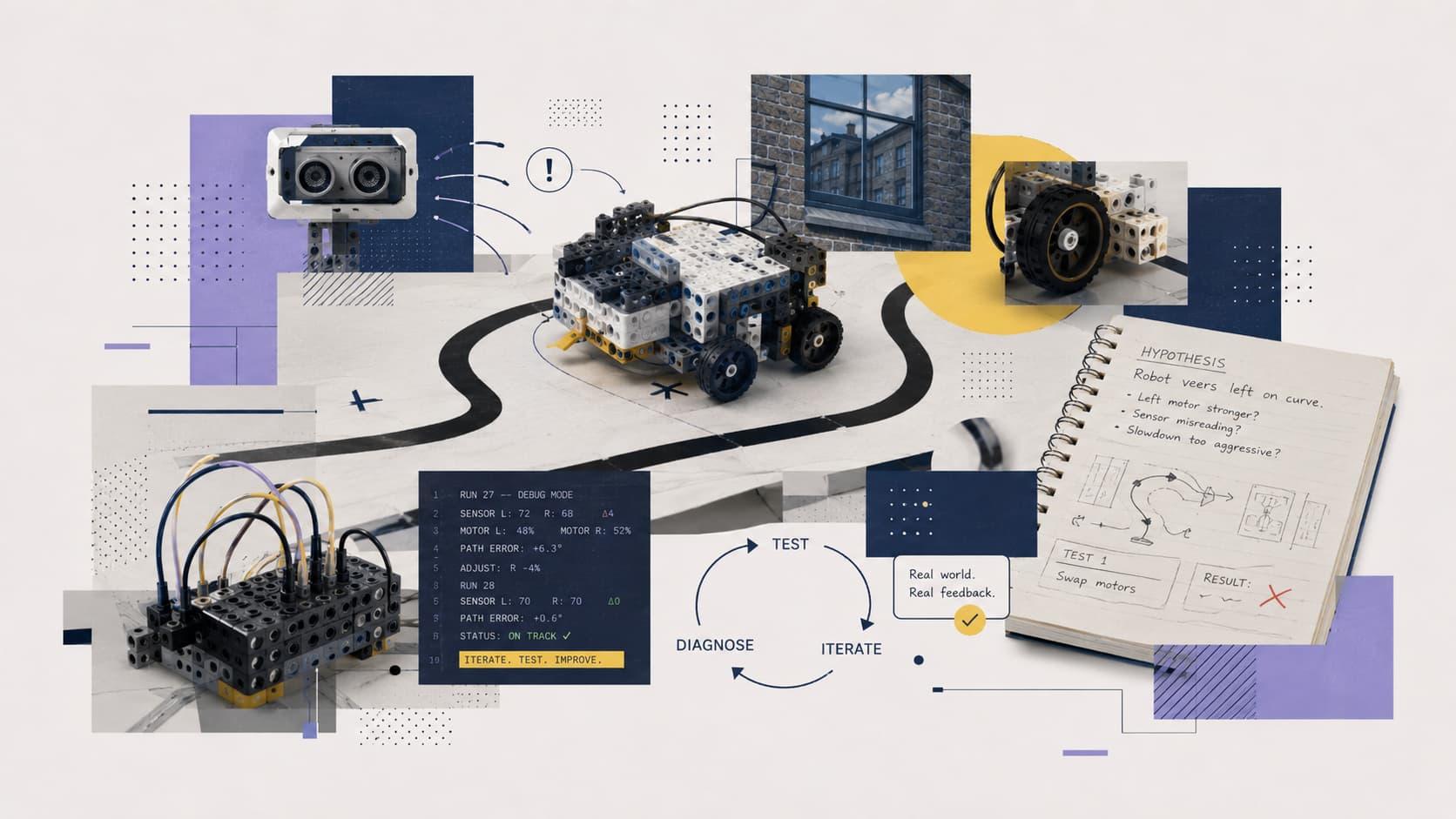
There is a moment that happens in almost every BotLab session. A student programmes an instruction, the robot moves — and then does exactly the wrong thing. Not what they intended, not what they typed. Something completely different.
They look confused. Then they start asking why.
That moment of confusion is, we would argue, more valuable than any tutorial exercise. Here is why.
The problem with screen-only coding education
Screen-based coding platforms have made enormous progress. They are accessible, free and scalable. Millions of students have been introduced to programming through block editors, browser games and tutorial sequences.
But they share a common limitation: the feedback loop is entirely digital. When code runs incorrectly on a screen, the consequence is an error message or a sprite moving the wrong direction. The cost of failure is near zero. You click undo and try again.
In a physical environment, the cost of failure feels different — and that difference matters.
What physical robotics adds
When a robot you have built falls over, skews sideways, or fails to stop at the line it was supposed to stop at, you have to diagnose a problem in the real world. That means:
- Checking whether the sensor reading matches what you expected
- Testing whether the motor speed you set translates correctly to movement on an actual surface
- Considering whether your code logic is right, or whether there is a hardware issue
- Eliminating variables, forming a hypothesis and testing it
This is the engineering process. Not as a concept explained in a slide — as something you have to actually do because your robot is sitting in front of you, not working.
Why small groups matter
We cap our sessions at eight to ten students. This is deliberate. With larger groups, students who are stuck tend to wait for help rather than investigate the problem themselves. With smaller groups, there is nowhere to hide — and more importantly, no need to. Every student gets direct time with an instructor, and the culture shifts toward curiosity rather than performance.
We have also found that the best learning often happens between students. When one person solves a problem that another person is struggling with, the explanation they give is usually clearer than any instructor explanation — because they just figured it out themselves.
Real tools, real confidence
We use the same development environments, sensors and actuators that appear in professional robotics and engineering. The step from our sessions to a university engineering lab is shorter than most students expect.
More importantly, students leave with something a tutorial cannot give them: the experience of having built something, broken it, fixed it, and made it work. That experience produces a specific kind of confidence — not "I finished the exercise" but "I solved a real problem".
Where screen-based coding fits in
We are not arguing against screen-based coding education. It is an excellent introduction to logic, sequencing and abstraction. For students who are curious about software, it is the right starting point.
But for students who want to understand how the physical world responds to instructions — how a sensor processes input, how a motor converts electrical signal to movement, how a programme behaves when friction and battery level and surface texture all affect the outcome — physical robotics is where that understanding develops.
That is what we build at BotLab. And it starts with that moment of confusion, when a robot does exactly the wrong thing and a student starts asking why.